
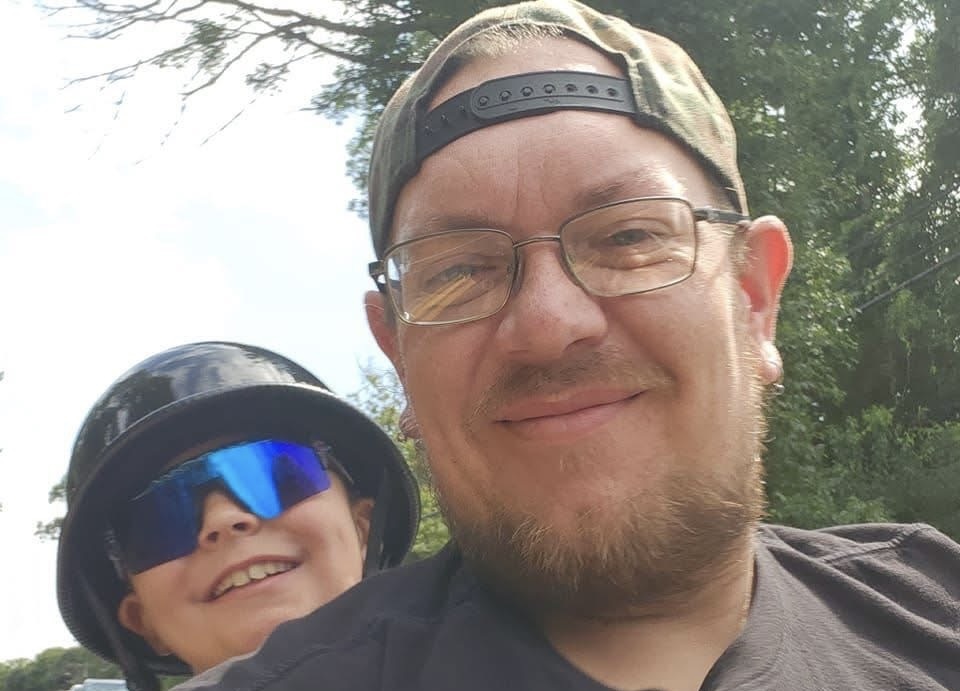
Jonathan J. Charron Critical: Plainfield Man Airlifted After Motorcycle Crash on Plainfield Pike Near New Road – Fled Trooper, Dumped Harley-Davidson on April 17, 2026
PLAINFIELD, Conn. – A serious motorcycle crash Thursday night on Plainfield Pike has left a 39-year-old Plainfield man fighting for his life after authorities say he fled from a Connecticut State Trooper attempting a traffic stop. The incident, which occurred near the intersection of Plainfield Pike and New Road, has raised questions about the risks of police pursuits and the devastating consequences of fleeing on a motorcycle.
The crash happened around 9:28 p.m. on April 17, 2026. According to the Connecticut State Police, a trooper observed a motorcycle — later identified as a Harley-Davidson — operating in a manner that prompted an attempted traffic stop. Instead of pulling over, the operator, Jonathan J. Charron, allegedly accelerated and tried to evade law enforcement.
Moments later, Charron lost control of the motorcycle and “dumped” the bike, according to initial reports. The Harley-Davidson left the roadway and crashed into a wooded area off Plainfield Pike. Responding emergency crews located the heavily damaged motorcycle and found Charron suffering from catastrophic injuries.
Charron was initially transported by ambulance to a nearby hospital, but due to the severity of his injuries, he was airlifted by Lifestar — Connecticut’s critical care air ambulance service — to a hospital in Rhode Island. As of the latest reports, Charron remains in critical condition, with medical teams working around the clock to stabilize him.
The crash remains under investigation by the Connecticut State Police. No further details have been released regarding the reason for the initial traffic stop, Charron’s speed or behavior before the crash, or whether any charges will be filed if he survives.
The Incident: What Happened on Plainfield Pike
Plainfield Pike is a two-lane road that runs through rural and residential areas of Plainfield, a small town in Windham County in northeastern Connecticut. The intersection with New Road is a relatively quiet junction, but at night, visibility can be limited, and curves in the road present hazards for motorcyclists traveling at high speeds.
According to the Connecticut State Police, the trooper attempted to initiate a traffic stop shortly before 9:30 p.m. The reason for the stop has not been disclosed — it could have been for a moving violation such as speeding, an equipment issue, or something unrelated to the motorcycle’s operation. What is clear is that Charron did not comply.
“The operator failed to stop and instead attempted to flee,” said a State Police spokesperson. “Shortly thereafter, he lost control of the motorcycle and crashed.”
The term “dumped the bike” is motorcycle slang for losing control and being thrown from the vehicle, often without the involvement of another vehicle. In this case, the Harley-Davidson left the roadway and came to rest in a wooded area, suggesting that Charron may have been traveling at a significant speed when he lost control.
Emergency crews from Plainfield Fire Department and American Ambulance responded to the scene. They found Charron with life-threatening injuries, including possible head trauma, internal bleeding, and multiple fractures. After initial stabilization at a local hospital, the decision was made to transfer him by Lifestar to a trauma center in Rhode Island, which has specialized capabilities for severe motorcycle crash injuries.
Lifestar is a helicopter-based emergency medical service that operates throughout Connecticut and surrounding states. The airlift typically reduces transport time to a trauma center from over an hour by ground to just 15-20 minutes, which can be the difference between life and death in critical cases.
Who Is Jonathan J. Charron? A Plainfield Resident’s Life Interrupted
Jonathan J. Charron, 39, of Plainfield, is not a public figure, but his name has now become associated with a dramatic and potentially life-ending crash. According to public records, Charron has lived in Plainfield for several years. Neighbors describe him as a quiet man who kept to himself but was known to be an avid motorcycle enthusiast.
“I’ve seen him ride by on that Harley,” said a neighbor who asked not to be named. “He loved that bike. He’d be out working on it in his driveway on weekends. He seemed like a nice enough guy. It’s sad to hear this happened, but you have to wonder — why didn’t he just pull over?”
Friends of Charron have expressed shock at the news. “Jon is a good dude,” said a childhood friend, Mike R. “He’s made some mistakes in the past, but who hasn’t? He’s not a criminal. I don’t know why he ran. Maybe he panicked. Maybe he had a reason. But now he might die for a traffic stop. That’s insane.”
Charron’s family has not released a public statement, but sources close to them say they are devastated and have gathered at the Rhode Island hospital where he is being treated. “They’re just praying he makes it,” said a family friend. “Everything else — the investigation, the charges, the media — that can wait. Right now, it’s about keeping him alive.”
The Aftermath: Investigation and Legal Questions
The Connecticut State Police’s Collision Analysis and Reconstruction Squad (CARS) is leading the investigation. Key questions include: Why did the trooper attempt to stop Charron? How fast was Charron going when he lost control? Were there any other factors — such as road conditions, mechanical failure, or impairment — that contributed to the crash?
Toxicology results for Charron are pending. If alcohol or drugs are found to be a factor, that could lead to additional charges, regardless of whether he survives. Fleeing from police is itself a crime — in Connecticut, evading responsibility (commonly known as “eluding”) can be charged as a felony if it results in serious injury or death.
“If Mr. Charron survives, he could face serious legal consequences,” said a legal analyst not involved in the case. “But the priority right now is his health. The criminal justice system will wait.”
The trooper involved in the attempted stop has been placed on administrative duty pending an internal review, which is standard procedure in such incidents. The Connecticut State Police have not released the trooper’s name. Body camera footage, if available, may be released as part of the investigation, though police have not commented on whether the trooper’s camera was activated.
The Risks of Fleeing on a Motorcycle
Law enforcement experts and motorcycle safety advocates agree that fleeing from police on a motorcycle is extraordinarily dangerous. Unlike a car, a motorcycle offers no protective cage, no seatbelt, and no airbags. A crash at even moderate speeds can result in catastrophic injuries or death.
“When a motorcyclist flees, they are not just risking a ticket — they are risking their life,” said Sgt. Tom Harris (ret.), a former motorcycle officer with a large metropolitan police department. “Motorcycles are unstable at high speeds. One small mistake — a patch of gravel, a curve taken too fast — and you’re down. And when you go down on a bike, you lose.”
Data from the National Highway Traffic Safety Administration (NHTSA) shows that motorcyclists are 28 times more likely to die in a crash than passenger vehicle occupants. In pursuit-related crashes, the fatality rate for motorcyclists is even higher. A 2023 study by the National Institute of Justice found that 42% of police pursuits involving motorcycles ended in a crash, and nearly a third of those crashes resulted in death or life-altering injury.
“It’s just not worth it,” Harris added. “Even if you have a suspended license or a warrant for something minor, the risk of running is far greater than the risk of pulling over. Pull over, be polite, and deal with the consequences later. At least you’ll be alive.”
Community Reaction: Shock and Debate
The crash has sparked debate in Plainfield and beyond. Some residents express sympathy for Charron, regardless of his decision to flee. “He’s a human being,” said a woman at a local coffee shop. “He made a terrible choice in a moment of panic. That doesn’t mean he deserves to die. I hope he pulls through.”
Others are less forgiving. “He ran from the police,” said a man waiting for his car at a repair shop. “He put the trooper and everyone else on the road at risk. He made his bed. It’s sad, but actions have consequences.”
The Connecticut State Police have not yet announced whether they will change any pursuit policies as a result of this incident. Currently, state police policy allows pursuits when the suspect poses an imminent threat to public safety or when the need to apprehend outweighs the risks. In practice, many departments are moving toward limiting pursuits of motorcycles, given the high likelihood of crash and injury.
“We are constantly evaluating our procedures,” the State Police spokesperson said. “Every incident is reviewed. But we cannot comment on any potential changes at this time.”
The Role of Lifestar and Trauma Care
Charron’s survival may depend on the speed and quality of medical care he received. Lifestar, which airlifted him to Rhode Island, is a critical component of Connecticut’s emergency medical system. The service operates out of Hartford Hospital and responds to traumatic injuries across the state.
“Lifestar is essentially a flying intensive care unit,” said Dr. Alan Resnick, a trauma surgeon at a major Connecticut hospital, speaking generally. “For patients with severe head injuries, internal bleeding, or spinal trauma, getting them to a Level I trauma center within the ‘golden hour’ — the first 60 minutes after injury — dramatically improves survival rates.”
The Rhode Island hospital where Charron was taken is a designated trauma center with specialized capabilities for orthopedic and neurological injuries — common in motorcycle crashes. He is reported to be in critical condition, meaning his vital signs are unstable and he requires constant monitoring and intervention.
“Critical condition does not mean hopeless,” Dr. Resnick said. “It means the patient is very sick and the next 24 to 72 hours will determine the outcome. Young, otherwise healthy patients can survive even very severe trauma if they receive excellent care.”
The Emotional Toll on First Responders
The crash also took an emotional toll on the first responders who arrived on the scene. Police officers, firefighters, and paramedics are trained to handle traumatic incidents, but seeing a fellow community member — especially one who is critically injured — can be deeply affecting.
“We see a lot of motorcycle crashes,” said a Plainfield firefighter who spoke on condition of anonymity. “They’re always bad. The human body is not designed to hit the ground at 50, 60, 70 miles an hour. You do your job, you try to save them, and then you go home and try to forget. But you don’t always forget.”
The firefighter added that the decision to flee adds another layer of frustration. “It’s hard to have sympathy when someone made a choice to run. But then you see them lying there, bleeding, and you just do your job. You don’t judge. You treat.”
The Connecticut State Police have offered counseling services to any personnel involved in the incident, as is standard after a serious crash or pursuit.
A Reminder of Life’s Fragility
As Jonathan J. Charron fights for his life in a Rhode Island hospital, his story serves as a sobering reminder of how quickly a decision — even a split-second decision — can change everything. A routine traffic stop, intended to enforce a minor violation, spiraled into a high-speed flight and a near-fatal crash.
For Charron’s family, the wait is agonizing. For the trooper who initiated the stop, there may be sleepless nights and difficult questions. For the community of Plainfield, a quiet town known more for its farms and forests than its crime rates, the crash has brought an unwelcome spotlight.
But beyond the headlines and the legal debates, there is a man — a son, perhaps a father or brother — lying in a hospital bed, surrounded by machines, fighting to stay alive. And whatever led him to run, he is not alone. People are praying for him. People are hoping.
“I don’t know Jon personally,” said a woman who left flowers at the crash site. “But I know he’s somebody’s somebody. And nobody should die like that — alone, in the woods, on a motorcycle. I hope he makes it. I hope he gets a second chance.”
What Happens Next
The Connecticut State Police will continue their investigation over the coming weeks. A final report will be submitted to the Windham County State’s Attorney’s Office, which will determine whether any criminal charges are warranted. If Charron survives and is released from the hospital, he may face charges including evading responsibility, reckless driving, and potentially assault on a police officer if the pursuit endangered the trooper.
If Charron does not survive, the case will be closed with his death, though the investigation will still be completed for statistical and policy review purposes.
Regardless of the outcome, the crash on Plainfield Pike near New Road will be studied — by law enforcement, by safety advocates, and by a community that wants to prevent the next tragedy.
“We need to ask ourselves tough questions,” said a local pastor. “Why are people so afraid to pull over? What’s happening in our society that a traffic stop becomes a death sentence? And how can we do better — as a police force, as a community, as human beings?”
Conclusion: A Life in the Balance
As this article is being written, Jonathan J. Charron remains in critical condition. His family holds vigil. The trooper who tried to stop him waits for answers. And the people of Plainfield — some sympathetic, some critical, all saddened — reflect on a Thursday night that changed everything.
The crash is a tragedy, no matter how you look at it. A man is fighting for his life. A family is in anguish. A community is mourning what could have been. And while questions remain about why Charron fled, one thing is certain: a traffic stop should never be a death sentence.
May Jonathan J. Charron find the strength to survive. May his family find peace. And may all of us — drivers, riders, and law enforcement alike — learn something from this painful moment.
The investigation is ongoing. Anyone with information about the crash is asked to contact the Connecticut State Police at (860) 779-4900. For those in need of trauma or grief support, the National Crisis Lifeline is available 24/7 by dialing 988.
Leave a Reply